

How much do truck drivers make per mile in 2026?
If you’re an experienced CDL A driver comparing trucking jobs, knowing the average pay per mile for truck drivers is a useful starting point. But the advertised cents-per-mile (CPM) rate doesn’t tell the whole story. Two carriers can offer similar rates while delivering very different paychecks. Freight availability, loaded and empty-mile compensation, detention policies, and opportunities for higher pay all affect your actual earnings.
Here’s what current salary data tells us about truck driver pay per mile in 2026 — and what matters most when comparing offers.
What is the average truck driver pay per mile in 2026?
There isn’t one official national average CPM rate for truck drivers. Compensation varies by experience, freight type, route, carrier, and pay structure.
According to the U.S. Bureau of Labor Statistics, the median annual wage for heavy and tractor-trailer truck drivers was $58,640 in May 2025.
ZipRecruiter estimates average annual pay for its “Truck Driver Per Mile” salary category at approximately $56,348 as of October 2026.
These figures provide useful context, but neither represents a national average CPM rate. Annual earnings include drivers working under different compensation arrangements, schedules, and mileage levels.
For an experienced driver evaluating a new position, the more useful question is how the advertised rate translates into actual weekly earnings.
What actually determines your earnings per mile?
Experienced CDL A drivers know that the advertised CPM rate is only part of the equation. What matters is how that rate translates into consistent weekly earnings. Here’s how weekly base mileage pay compares at different rates and mileage levels:
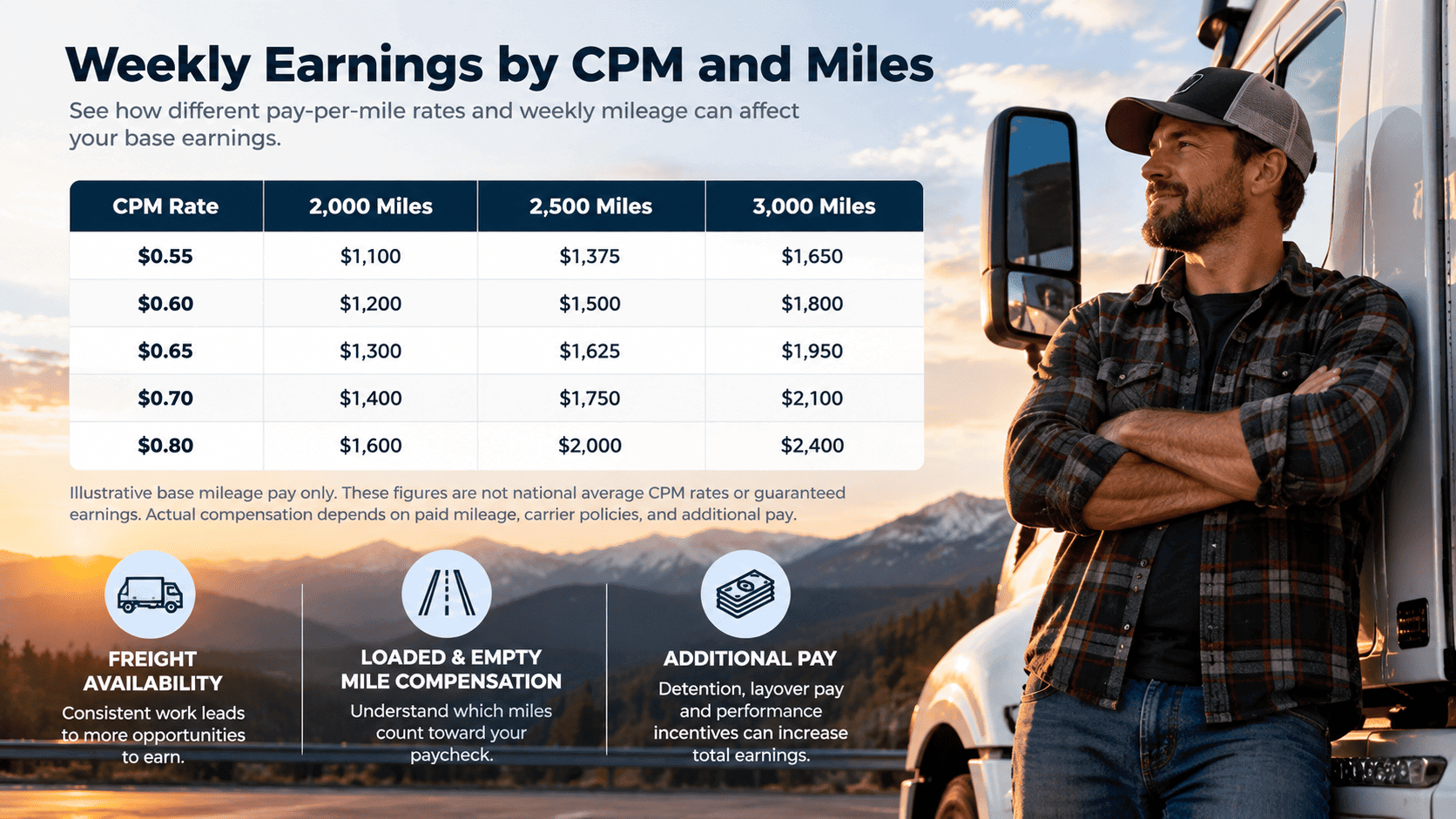
The biggest differences between trucking offers often come down to three things:
- Consistent freight and mileage. A competitive CPM means less when load availability is unpredictable.
- Loaded and empty-mile compensation. Understanding which miles count toward your paycheck can reveal major differences between seemingly similar offers.
- Additional compensation. Detention pay, performance incentives, and other payments can affect total earnings.
The goal isn’t simply to find the highest advertised CPM. It’s to find a carrier that offers a competitive rate, dependable freight, and clear compensation terms.
Why a higher CPM doesn’t always mean a bigger paycheck
Consider two hypothetical trucking offers.
Carrier A
- Advertised rate: $0.75 CPM
- Weekly paid mileage: 1,800 miles
- Base mileage pay: $1,350
Carrier B
- Advertised rate: $0.68 CPM
- Weekly paid mileage: 2,500 miles
- Base mileage pay: $1,700
Despite offering a lower CPM, Carrier B generates $350 more in base mileage pay that week.
Of course, mileage can fluctuate due to freight demand, weather, scheduling, and other factors. One week doesn’t establish a carrier’s typical earning potential.
That’s why experienced drivers should evaluate both the advertised rate and the consistency of available work over time.
Loaded vs. empty miles: what are you actually getting paid for?
Not every mile you drive has freight in the trailer. Loaded miles are driven while transporting freight. Empty miles, also called deadhead miles, are driven without a load, often while repositioning for the next pickup.
Carriers handle empty-mile compensation differently. Some pay the same rate for loaded and empty miles, while others apply separate rates or restrictions.
Here’s an example:
- Loaded miles: 2,300
- Empty miles: 200
- CPM rate: $0.70
Loaded miles only: $1,610
Loaded and empty miles at the same rate: $1,750
That’s a $140 difference for the same trip.
When comparing offers, clarify whether the advertised rate covers all dispatched miles, loaded miles only, or different mileage categories. It’s also worth asking how mileage is calculated. Some carriers use practical or shortest-route mileage rather than actual odometer miles. The difference between miles driven and miles compensated can have a meaningful impact on your paycheck.
What else affects a truck driver’s weekly pay?
Beyond the advertised CPM, several factors can influence your overall compensation.
Detention pay
Detention occurs when a driver spends longer than expected waiting at a shipper or receiver. Some carriers compensate eligible detention time, but the rules vary. Payment may depend on waiting-time thresholds, documentation, and approval from a broker or customer. Before accepting an offer, ask when detention compensation begins, what qualifies, and how payments are processed.
Layover pay
A layover generally involves an extended wait between loads or while a driver is unable to continue a scheduled trip. Compensation policies differ by carrier. Some offer a flat payment for qualifying layovers, while others have specific eligibility requirements.
Safety and performance incentives
Some carriers offer higher rates or additional compensation based on a driver’s safety record, experience, tenure, or performance. When reviewing an offer, ask which incentives are available, how drivers qualify, and whether they are recurring or one-time payments.
Freight availability and dispatch
Reliable freight is one of the most important factors behind consistent mileage earnings. A strong CPM rate can lose much of its value when a driver regularly waits for the next load. Efficient dispatch, freight availability, and realistic scheduling all influence earning opportunities.
Solo vs. Team driving
Team operations allow two qualified drivers to share driving responsibilities and potentially keep the truck moving for longer periods. However, compensation structures vary. A team CPM rate may be quoted per driver or for the truck, depending on the carrier. Before comparing solo and team opportunities, confirm how mileage is credited and how compensation is divided.
How much can truck drivers earn per year?
Annual earnings depend on more than the advertised mileage rate. For example, a driver averaging 2,500 compensated miles per week at $0.70 CPM would generate $1,750 in weekly base mileage pay. If that mileage and rate remained consistent for 48 paid weeks, the annual base mileage total would be $84,000 before additional compensation and applicable taxes or deductions. That’s a hypothetical calculation, not an estimate of typical earnings or a guarantee of available miles.
Actual annual income depends on freight availability, home time, time off, delays, and the driver’s compensation arrangement. Drivers should also distinguish between gross earnings and take-home pay, particularly when comparing W-2 employment with 1099 independent contractor arrangements.
Do reefer truck drivers make more per mile?
Refrigerated trucking, commonly known as reefer trucking, involves transporting temperature-sensitive freight that requires controlled conditions. Reefer drivers may have additional responsibilities, including monitoring trailer temperatures, verifying settings, and following specific handling procedures. Some refrigerated carriers offer competitive mileage rates to attract experienced CDL A drivers. However, reefer work doesn’t automatically guarantee higher pay than dry van or other trucking operations. The better comparison is the complete offer: compensation, freight consistency, operating conditions, additional payments, and support. For drivers considering reefer opportunities, understanding how the carrier handles delays, equipment issues, and empty miles can be just as important as the CPM itself.
How to compare truck driving jobs beyond CPM
Before choosing your next carrier, ask these seven questions:
- What’s my starting CPM? Does my experience or driving record affect the initial rate?
- Which miles are compensated? Loaded, empty, or both?
- How is mileage calculated? Does the company use practical miles, shortest-route miles, or another method?
- How consistent is the freight? What can drivers realistically expect from available loads?
- What happens during delays? Are detention or layover payments available, and under what conditions?
- Can my CPM increase? Are raises tied to tenure, safety, routes, or performance?
- What’s the full compensation arrangement? Is the position W-2 or 1099, and what benefits, deductions, or tax responsibilities apply?
Clear answers make it easier to evaluate the actual earning opportunity rather than relying on the largest number in a job advertisement.
Truck driver pay at STI Trucking
At STI Trucking, we understand that experienced CDL A drivers look beyond the advertised rate. Consistent work, transparent compensation, and dependable support matter just as much.
We’re a nationwide refrigerated carrier with a fleet of more than 100 trucks, offering opportunities for qualified CDL Class A drivers.
Here’s what drivers can expect from our compensation and operating model:
- Competitive CPM opportunities. Starting rates depend on the position and driver qualifications.
- Paid empty miles. Empty-mile compensation is part of our driver pay structure.
- 98% trailers are pre-loaded. Spend less time waiting for freight to be loaded and more time on the road earning.
- Opportunities for higher CPM. Rate increases may be available based on completed years with STI Trucking, a clean driving record, and route or mileage commitments.
- 24/7 driver support. Our team is available to assist drivers on the road.
We offer solo and team driving opportunities, with routes and availability depending on operational needs.
Looking for your next CDL A driving opportunity?
If you’re an experienced CDL Class A driver looking for competitive compensation, consistent freight opportunities, and a team that understands life on the road, explore what STI Trucking has to offer:
Explore CDL A Driving Opportunities at STI Trucking